
Writing Without Fear
The early black abolitionist David Walker thought he might be killed for his words against slavery, but he wrote them anyway
Run It Back offers carefully researched articles on lesser told parts of black history. But I’m only able to do this work with your help. Please consider getting a paid subscription to Run It Back to help me keep writing these stories and making them widely available to students, educators and lifelong learners.
There’s speaking truth to power, and then there’s David Walker’s Appeal to the Coloured Citizens of the World. Walker, a free black man in Boston, published an 88-page abolitionist broadside in 1829 against slavery, white supremacy, and the rotten hypocrisy of American Christianity. Before Douglass or Du Bois or Malcolm X, Walker launched a rhetorical war on the American project, contrasting the democratic ideals of the Founding Fathers with the savagery of the slave system they allowed to propagate in the new republic.
Walker’s words were radical for their time, or any time. But they were not out of step with how many black people likely felt as their rights were stripped away in the early 1800’s and enslavement became increasingly brutal. “You are not astonished at my saying we hate you,” he wrote in one passage addressing white America, “for if we are men we cannot but hate you, while you are treating us like dogs.”1
“The whites want slaves, and want us for their slaves, but some of them will curse the day they ever saw us,” he vowed later in the Appeal. “As true as the sun ever shone in its meridian splendor, my colour will root some of them out of the very face of the earth.”2
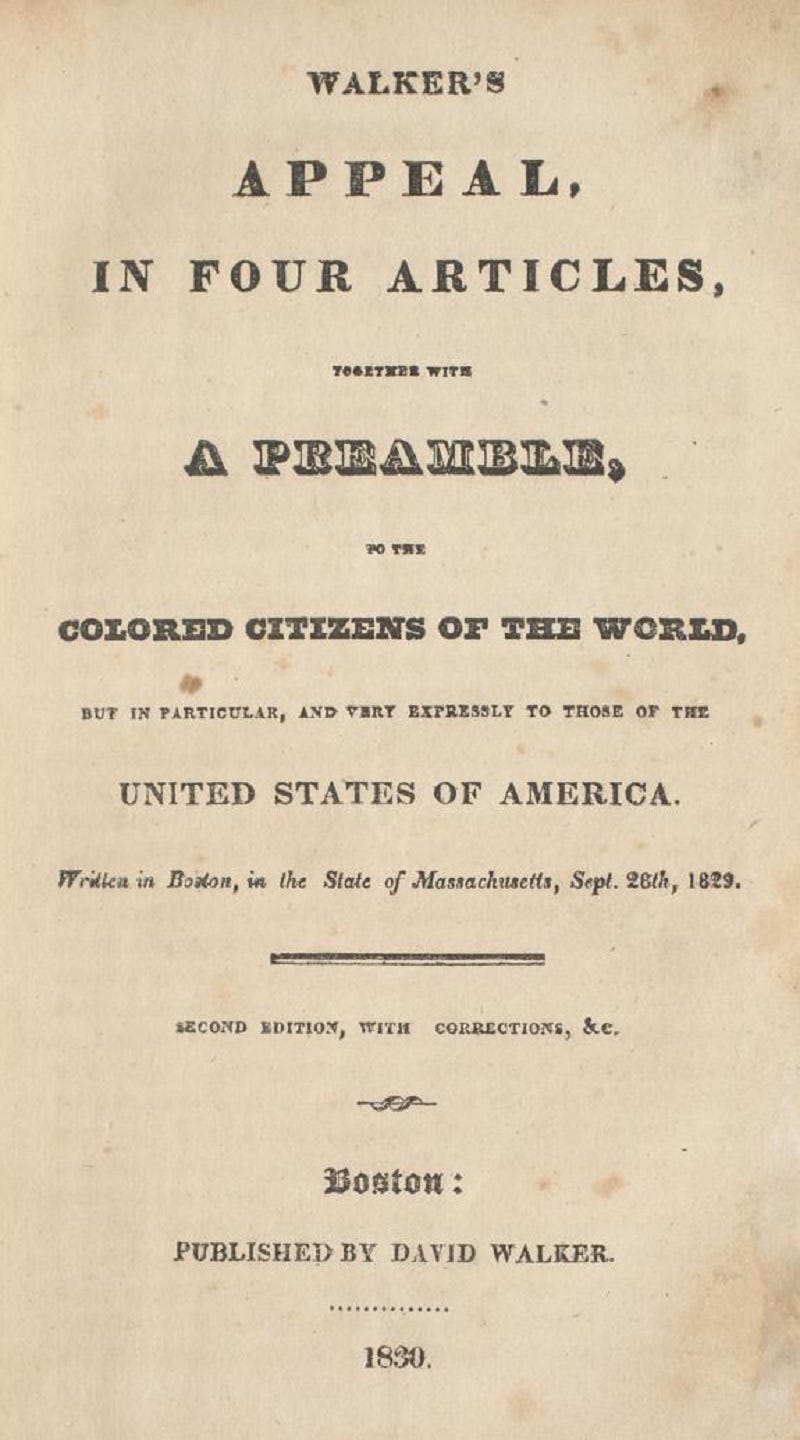
The entire treatise unfurls at this register, pinballing between points with a tactical recklessness (think Tupac’s Hit Em Up for the antebellum era). Walker predicted he would be censored or even killed for his words. But beyond the fiery rhetoric, the core of Walker’s argument was this: Black Americans had been wronged more than any other group in the history of the world under the U.S. slave system, and if they were not freed immediately, the comeuppance for white Americans would be Biblical.
—
David Walker grew up near slavery but not under it. Born in Wilmington, North Carolina around 1796, he was one of only a handful of free black people living in the coastal town at the turn of the 19th century. From a young age he observed enslaved people working as sailors and lumberers, keeping the port city’s economy afloat while receiving nothing in return. He learned early that black people could perform just as competently as their white peers.3
In the late 1810’s he moved to Charleston, which had one of the largest free black populations in the South.4 While he was living there, an African Methodist Episcopal minister named Denmark Vesey laid out an elaborate plan to raid Charleston’s weapons arsenal, murder local whites and set the city ablaze in a mass slave rebellion. Vesey’s plot was foiled before it could begin when some co-conspirators tipped off local authorities, and he was soon executed.5 It’s unclear whether Walker was involved with the Vesey affair, but he’d ultimately come to advocate for armed resistance to enslavement in his writings.
Walker soon relocated to Boston and opened a used clothing store in the black business district. He became immersed in the city’s activist black professional class–he joined the Prince Masons, became a member of the Massachusetts General Colored Association, and worked as an agent for Freedom’s Journal, the nation’s first black newspaper.6 All the while, he was reading voraciously, delving deep into the history of previous slaveholding societies such as ancient Rome and Egypt. According to one report, he spent at least four years studying global history and the Bible in order to craft his provocative argument.7
Walker’s Appeal to the Coloured Citizens of the World was a unique blend of historical analysis, firsthand observation of racism in America, and religious fervor . Walker is animated throughout the text, but he comes most alive when challenging some of the nation’s sacred cows. Thomas Jefferson proves a useful foil. Walker returns multiple times to Notes on the State of Virginia, a 1785 book in which Jefferson declares that Black people are inferior to whites intellectually due to genetic deficiencies (“in imagination they are dull, tasteless, and anomalous,” reads one passage).8 Walker, practically rolling his eyes from the page, wonders how Jefferson could shrug off the circumstances that had stymied black progress for two centuries. “It is indeed surprising, that a man of such great learning..should speak so of a set of men in chains,” he wrote.9
Walker went further when he pointed out the hypocrisies laden in Jefferson’s crowning rhetorical achievement, the Declaration of Independence. “Compare your own language…from your Declaration of Independence, with your cruelties and murders inflicted by your cruel and unmerciful fathers and yourselves on our fathers and on us,” Walker wrote. “Men who have never given your fathers or you the least provocation!!!!!!”10
But as much as he seemed to delight in pillorying a Founding Father, Walker understood that Jefferson’s words carried the weight of dogma, so he called on his black peers to disprove them. “I am glad Mr. Jefferson has advanced his positions for your sake,” Walker wrote, “for you will either have to contradict or confirm him by your own actions.”11
Walker envisioned his Appeal as a spark for liberation in Black America, an echo of Thomas Paine’s Common Sense before the American Revolution. Leveraging his shipping contacts as a merchant in Boston, he had the book smuggled aboard steamships that docked in Savannah, New Orleans, and his hometown of Wilmington. He tapped into runaway slave networks that were able to carry the text further inland.12 Because most slaves couldn’t read, he called on literate black people to narrate the work aloud at community gatherings. The Appeal was more sermon than scholarly work, a call to action for every soul who laid eyes or ears on it. “Your full glory and happiness, as well as all other coloured people under Heaven, shall never be fully consummated, but with the entire emancipation of your enslaved brethren all over the world,” he wrote.13
The Appeal was seen as a ticking time bomb by white slave owners in the South, and they did everything in their power to defuse it. Following rumors that slaves in the town of New Bern had armed themselves after reading the Appeal, North Carolina’s legislature passed new laws banning the book and criminalizing slave literacy. In Charleston, a white mariner was arrested for circulating the text among black longshoremen. In Louisiana, a vicious new law decreed that anyone who wrote or distributed materials that could cause “insubordination among the slaves” could face life imprisonment or death.14 The scope and severity of the enforcement against the Appeal hints at how effectively it managed to circulate in the South.
Despite its impact when it was published, the Appeal’s historical resonance waned over time. Laws aimed at limiting the work’s spread eventually smothered its virality. Nat Turner’s Rebellion in 1831 became a greater flashpoint of black resistance and white backlash in the era. And Walker himself died in 1830 of tuberculosis, never getting a chance to build on his arguments. He was just 33 years old.15
Still, the Appeal has lived a long life circulating outside of classroom curricula and general history textbooks. Frederick Douglass cited it as a central influence, and W.E.B. Du Bois once called it “that tremendous indictment of slavery.”16 The Appeal has that “your favorite band’s favorite band” notoriety attached to it.
Even in 2026, Walker’s words are furious and bracing, far outside the bounds of what black people are expected to say or think. Before pushing his brethren toward radical action, though, Walker understood that he had to push them toward radical thought. Instead of asking for equality, he demanded it. "Should tyrants take it into their heads to emancipate any of you, remember that your freedom is your natural right,” he wrote. “You are men, as well as they, and instead of returning thanks to them for your freedom, return it to the Holy Ghost, who is our rightful owner."17
David Walker, Walker’s Appeal, in Four Articles; Together With a Preamble, to the Coloured Citizens of the World, but in Particular, and Very Expressly, to Those of the United States of America (1829), p. 79, https://docsouth.unc.edu/nc/walker/walker.html
Walker’s Appeal, p. 23, https://docsouth.unc.edu/nc/walker/walker.html
Peter P. Hinks, To Awaken My Afflicted Brethren: David Walker and the Problem of Antebelleum Slave Resistance (University Park, PA: Pennsylvania State University Press, 1997), p. 9-11.
To Awaken My Afflicted Brethren, p. 21
“Denmark Vesey,” This Far By Faith, PBS, https://www.pbs.org/thisfarbyfaith/people/denmark_vesey.html
To Awaken My Afflicted Brethren, p. 67-75
“Walker’s Appeal,” The Liberator, Jan. 29, 1831, p. 1.
Thomas Jefferson, Notes on the State of Virginia (Paris: 1785), https://avalon.law.yale.edu/18th_century/jeffvir.asp
Walker’s Appeal, p. 12, https://docsouth.unc.edu/nc/walker/walker.html
Walker’s Appeal, p. 85, https://docsouth.unc.edu/nc/walker/walker.html
Walker’s Appeal, p. 32, https://docsouth.unc.edu/nc/walker/walker.html
To Awaken My Afflicted Brethren, p. 118, 138, 145, 149
Walker’s Appeal, p. 34, https://docsouth.unc.edu/nc/walker/walker.html
To Awaken My Afflicted Brethren, p. 145, 150
To Awaken My Afflicted Brethren, p. 269
To Awaken My Afflicted Brethren, p. 113-115
To Awaken My Afflicted Brethren, p. 81